Finite Element Method (FEM) or Finite Element Analysis (FEA) !!!
Finite Element Method (FEM) Or Finite Element Analysis (FEA)

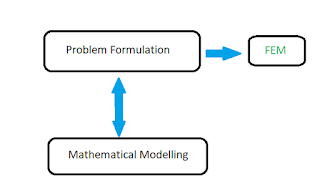
Finite Element Method (FEM) is a computer aided mathematical technique to find approximate numerical solution to wide variety of engineering science problems where it is not possible to find closed form solution.
Q.1 What is closed form solution?
Answer: A closed form solution is a simple solution of a problem with lot of assumptions basically, called exact solution. That means for a given problem or equation if the given problem can be solved in terms of functions and mathematical operations using a finite number of standard operations, it is called closed form solution.
Q.2 What are the features of Finite Element Method?
Answer:
1) FEM can handle any engineering science problem whose physical
phenomenon can be described by equation of calculus (Normal differential
equation) with any irregular, non-uniform loading and non-linear properties.
2) FEM based general purpose software can be developed easily
because it has very systematic procedure to solve a given problem.
Q.3
What are the areas of application of Finite Element Method?
Answer: Almost every field of engineering has FEM
Application.
For example:
1. Mechanical Engineering:
In mechanical engineering, FEM applications include steady and transient thermal analysis in solids and fluids, stress analysis in solids, automotive design and analysis and manufacturing process simulation.
2. Geo-technical Engineering:
FEM applications include
stress analysis, slope stability analysis, soil structure interactions, seepage
of fluids in soils and rocks, analysis of dams, tunnels, bore holes,
propagation of stress waves and dynamic soil structure interaction.
3. Aerospace Engineering:
FEM is used for several purposes such as structural analysis for natural frequencies, modes shapes, response analysis and aerodynamics.
4. Nuclear engineering:
FEM applications include
steady and dynamic analysis of reactor containment structures,
thermo-viscoelastic analysis of reactor components, steady and transient
temperature-distribution analysis of reactors and related structures.
5. Electrical and electronics engineering:
FEM applications include
electrical network analysis, electromagnetics, insulation design analysis in
high-voltage equipments, dynamic analysis of motors and heat analysis in
electrical and electronic equipments.
6. Metallurgical, chemical engineering:
In metallurgical
engineering, FEM is used for the metallurgical process simulation, moulding and
casting.
In chemical engineering, FEM can be used in the simulation of chemical
processes, transport processes and chemical reaction simulations.
7. Meteorology and bio-engineering:
In the recent times, FEM is
used in climate predictions, monsoon prediction and wind predictions.
FEM is also used in bio-engineering for the simulation of various
human organs, blood circulation prediction and even total synthesis of human
body.
---------------------------------------------------------------------------------
Best Books to understand the topic in details:
- Practical Finite Element Analysis by Nitin S.Gokhale
- Altair Student Guide
- Textbook of Finite Element Analysis by Seshu
- Introduction to Finite Element Method by J N Reddy
- Fundamentals of Finite Element Analysis by David Hutton
- Finite Element Analysis -Theory and Applications with Ansys by Saeed Moaveni

Comments
Post a Comment